
Blog

Top 10 Tile Display Rack Suppliers for Global Buyers

Tile display racks look like simple fixtures. In a busy showroom, they do harder work: supporting heavy samples, revealing surface texture, and helping buyers compare finishes without blocking the aisle. That is why choosing among Tile Display Rack Suppliers deserves more than a price check.

The market context is substantial. Grand View Research valued the global ceramic tiles market at about USD 217.09 billion in 2023 and projected continued growth through 2030. That figure describes tiles, not display racks. Still, it signals the scale of the product category these fixtures serve. For global buyers, supplier capability matters: check sample capacity, rack dimensions, materials, packaging, customization, and replacement-part support. Ask for load details and photographs of comparable installations. A polished catalog image is not proof of showroom performance.

Retail researcher Paco Underhill is often associated with the concise observation, “Retail is detail.” It fits here. A rack’s angle, labels, and sample spacing can shape what customers notice first. Small things matter.

This guide compares ten suppliers for international buyers, with attention to product range, manufacturing options, and communication. No supplier is right for every project. A compact rack may suit a neighborhood studio; a large showroom may need mobile panels and frequent sample changes. The comparison is a starting point, not a substitute for checking specifications, references, and shipping terms. One limitation remains: supplier claims can be difficult to compare consistently. Buyers should verify them before ordering.
Top 10 Tile Display Rack Suppliers for Global Buyers

Understanding Tile Display Racks and Their Role in Product Presentation

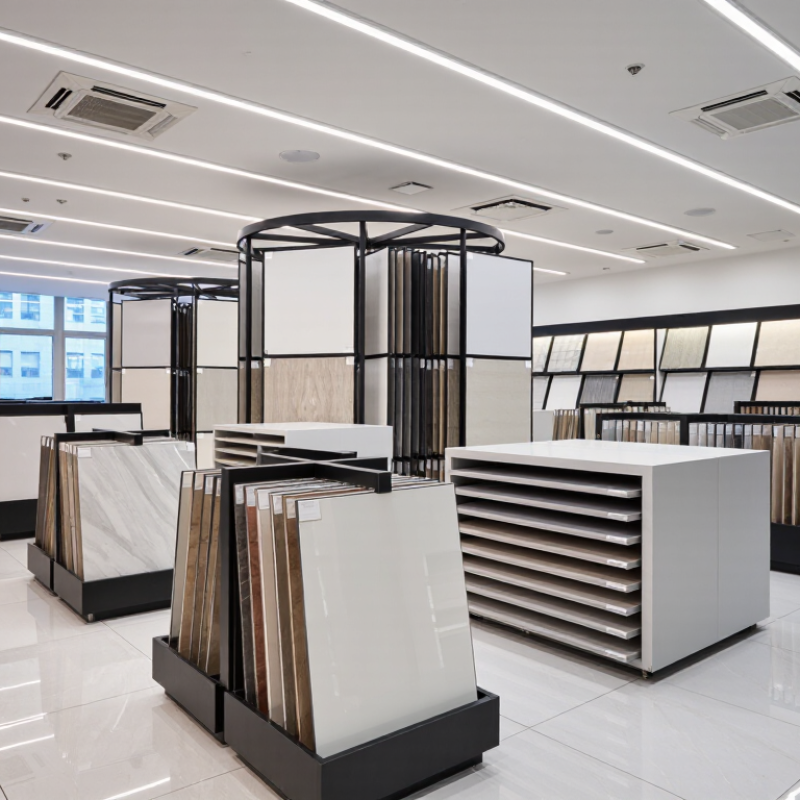
A tile display rack turns heavy, flat samples into products people can compare at a glance. Upright panels reveal color, surface texture, grout lines, and edge details without requiring customers to lift every piece. A well-planned layout also helps staff keep samples organized and return them to the correct position. Small details matter.

Rack design should match the tile format, sample weight, and showroom space. Check that shelves or panels support the samples securely, and leave enough room for hands to slide them out. Clear labels can show dimensions, finish, and relevant care information. Good lighting helps, but harsh glare may distort a glossy surface. Not always obvious. A display can make a tile look more uniform than it is, especially when natural variation appears across a full carton. Showing several pieces together can give buyers a more realistic impression. For global buyers, knock-down construction and replaceable parts may simplify packing and maintenance, though extra joints can affect stability. The best solution is rarely the most elaborate one; it is the rack that makes comparison easy while keeping samples safe and accessible.

Key Factors for Evaluating Tile Display Rack Suppliers

For global buyers, a tile display rack supplier should be judged on more than finish and price. Grand View Research estimated the global ceramic tile market at USD 227.9 billion in 2022, with projected growth of 6.3% annually through 2030. A larger, changing market makes repeatable production and dependable replenishment worth checking. Ask for factory capacity, lead times, and records of on-time delivery—not just a polished catalog. Small detail. Do sample racks arrive with chipped corners?

Technical evidence matters. Request load-test results for the exact rack configuration, including shelf deflection under representative tile weight. Check welds, fasteners, sharp edges, and whether sample boards can be replaced without dismantling the frame. Packaging deserves its own review: corner guards and restrained movement can prevent damage during long-distance freight. McKinsey Global Institute’s 2020 supply-chain analysis estimated that disruptions could cost companies the equivalent of 45% of one year’s profits over a decade. This is a cross-industry risk benchmark, not a rack-specific forecast.

Compare suppliers using the same drawing, tile dimensions, finish, and test conditions. Ask whether quoted capacity applies per shelf or to the whole unit; the difference is easy to miss. Verify material specifications and coating consistency across production batches. A showroom sample may look convincing, yet it cannot reveal how replacement parts are handled six months later. Request a written spare-parts policy and inspect a production unit before committing. One awkward truth: the lowest quote can become expensive when a damaged display delays a showroom opening.

Top 10 Tile Display Rack Suppliers for Global Buyers

Top 10 Tile Display Rack Suppliers for Global Buyers

Choosing a tile display rack supplier requires more than comparing prices. Ceramic World Review’s 2023 report estimated global tile production at about 16.1 billion square metres in 2022. That scale points to a broad, varied supply chain, but it does not guarantee consistent rack quality. Buyers should compare load capacity, adjustable sample angles, finish durability, and replacement-part availability. Ask for drawings and packed dimensions before ordering. A rack that fits a showroom may be awkward in a narrow container.

Tips: Request a sample or a short assembly video. Check whether rack edges protect polished tile surfaces. Confirm packaging measurements and test the supplier’s response to a technical question. Small details matter.

A useful top-ten shortlist should assess suppliers against the same criteria: export experience, production capacity, customization options, lead time, and clear quality checks. Request references from buyers in similar markets, where practical. Inspect welds, moving joints, and base stability on a loaded sample. These checks reveal more than glossy product photos. Still, supplier rankings can oversimplify things; a capable factory may not suit every order size or delivery schedule. State your tile dimensions and showroom layout early, then compare written quotations line by line.

Comparing Supplier Products, Services, and Market Reach

A useful comparison of tile display rack suppliers starts with the rack itself. Check whether shelves adjust for different tile thicknesses, and whether sample panels can be changed without tools. A rack holding heavy porcelain needs stable joints, a broad base, and clear load guidance. Small details matter. Ask for drawings, material specifications, and photos of finished units before approving a custom design. A low quote can hide thin steel or limited finish choices.

Service can separate similar offers. Compare sample lead times, packaging plans, spare-part availability, and the supplier’s response to installation questions. Request a packed-unit dimension and shipping weight; these affect warehouse handling and freight costs. Helpful suppliers explain trade-offs plainly. They should also confirm what is included, such as labels, assembly instructions, or replacement clips. Vague answers are a warning. Still, a polished sales response does not guarantee smooth production, and I may be giving communication too much weight.

Market reach is more than a list of export destinations. Ask how the supplier handles mixed orders, delivery to regional distributors, and protective packing for long-distance transport. Request references from buyers with comparable store formats or project volumes, then verify them where possible. A supplier serving many markets may offer flexible logistics, but smaller suppliers can provide closer design support. The best fit depends on your showroom footprint, shipment schedule, and willingness to manage details. One comparison sheet helps; it will not capture every production delay.

Top 10 Tile Display Rack Suppliers for Global Buyers - Comparing Supplier Products, Services, and Market Reach

Comparison note: Company names and brands are omitted. The rows describe common supplier types and typical capabilities in the tile-display market; they are not a verified ranking of individual companies. Confirm specifications, certifications, lead times, and export coverage directly with each supplier.

No. Supplier Type Typical Products Customization & Services Common Buyer Fit Typical Market Reach Key Evaluation Point
1 Metal rack manufacturer Freestanding, wall-mounted, and modular racks made primarily from steel. May offer custom dimensions, finishes, hooks, shelves, and logo-free signage panels. Tile retailers and distributors needing durable fixtures for showrooms. Domestic sales are common; export capability varies by factory and order size. Check load ratings, coating quality, packing method, and assembly requirements.
2 Tile sample-board specialist Boards, panels, and compact displays designed to present tile samples or collections. Often supports sample layout, board formats, collection updates, and protective packaging. Manufacturers, showrooms, and sales teams that circulate samples. Can serve local or international customers; shipping efficiency depends on board size and weight. Confirm sample compatibility, board durability, and ease of replacing samples.
3 Pull-out drawer rack supplier Cabinet-style displays with sliding trays for viewing multiple tile samples. May customize drawer count, tray size, cabinet finish, and showroom configuration. Showrooms that need high sample capacity in a compact floor area. Typically suited to project-based showroom orders; overseas delivery may require flat-pack options. Review slide performance, cabinet stability, and the maximum sample dimensions.
4 Rotating display rack supplier Rotating floor or countertop units for sample boards, small tiles, or product cards. May provide adjustable holders, different rotation formats, and custom graphics. Retail spaces seeking a compact display with access from multiple sides. Potentially suitable for retail channels in multiple regions, subject to packaging and freight costs. Check base stability, rotation mechanism, and safe loading limits.
5 A-frame and slab display specialist Heavy-duty frames for large-format tiles, slabs, or panels. May adapt frame width, support spacing, protective contact points, and handling features. Stone and tile warehouses, fabricators, and large-format showrooms. Often sold through regional industrial or building-material channels; transport is equipment-dependent. Verify rated capacity, restraint provisions, and handling guidance for loaded frames.
6 Modular display-system supplier Interchangeable uprights, shelves, panels, and accessories for configurable displays. Usually offers layout planning and combinations of standard components. Retailers and distributors that regularly change product assortments. Standardized components can simplify repeat orders across locations; confirm regional availability. Assess compatibility between modules and availability of replacement parts.
7 Countertop display supplier Small stands, sample holders, and compact display units for counters or desks. May offer custom holders, printed panels, and small-batch variations. Retail counters, sales offices, and trade-show presentations. Generally easier to ship than full-size racks, though destination-specific import costs still apply. Check footprint, sample fit, material finish, and protective packaging.
8 Wood-and-metal fixture maker Showroom furniture combining timber or panel construction with metal supports. May provide coordinated finishes, cabinetry, shelving, and made-to-order layouts. Showrooms seeking integrated display furniture rather than standalone racks. Large custom fixtures are often more practical for regional projects; export feasibility depends on packaging and installation. Confirm material specifications, finish samples, installation scope, and maintenance needs.
9 Retail fixture integrator Multiple display formats supplied as part of a broader store-fixture package. May coordinate measurements, layout planning, fixture selection, and project installation. Retail chains and showroom projects requiring several fixture types. Reach is often strongest where the integrator has local project teams or installation partners. Clarify project management, installation responsibility, and after-sales support by region.
10 OEM/ODM display producer Custom or adapted racks produced to buyer drawings, specifications, or sample requirements. May support prototyping, design revisions, private-label production, and production runs. Importers, distributors, and brands requiring a defined design or repeatable specification. International supply is possible, but minimum order quantities, freight, and import requirements vary. Request approved drawings, a pre-production sample, inspection criteria, and written tolerances.
Supplier capabilities and market reach are presented as typical category-level characteristics, not claims about any specific company.

Steps for Selecting and Sourcing the Right Display Rack Supplier

Choosing a tile display rack supplier starts with the tiles, not the catalogue. Measure sample size, weight, and how often staff will change displays. Large-format porcelain needs stronger shelves and secure edge support than small mosaic sheets. Bring real samples to supplier discussions. Small checks matter.

Ask for drawings, load ratings, material details, and a sample unit before approving a large order. Inspect welds, shelf spacing, finish, and how easily staff can replace tiles. A rack may look sturdy in a photo but feel awkward in a busy showroom. Fit comes first. Also confirm packaging protects corners and surfaces during transport, especially when racks ship assembled.

For international sourcing, specify the delivery destination, required date, packing method, and installation needs in writing. Compare total delivered cost, not just the quoted unit price. Request references or evidence of similar projects, then test a pilot order if timing allows. Custom features can improve usability, but they may extend lead times. It is tempting to finalize every detail early; still, checking aisle clearance with a physical sample can reveal problems that drawings miss. A little uncertainty is worth addressing before production.

How to use this checklist: The bars count practical verification items in each evaluation area; they are not supplier ratings or market survey results. Compare suppliers against the same checks, including rack dimensions and capacity, quality documentation, customization options, production capacity, packaging and shipping, commercial terms, and after-sales support.