
Blog
What Are the Top 10 Physiotherapy Tools and Equipment?
Physiotherapy is rarely about owning the most equipment. It is about choosing useful tools for a person’s goals, comfort, and stage of recovery. In a clinic, a resistance band may support controlled strengthening, while a balance pad can add a manageable challenge to standing exercises. Treatment tables, therapy balls, steps, weights, and mobility aids also help clinicians adapt activities to different needs. The right choice depends on assessment, not appearance.
This guide explores ten commonly used Physiotherapy Tools Equipment options and what each may contribute to a treatment setting. Some tools are simple and portable; others need more space, cleaning, or staff guidance. A foam roller, for example, may be convenient, but it is not suitable for every person or every exercise. Small details matter. So does supervision.
Equipment does not diagnose an injury or replace a qualified physiotherapist’s judgement. Its value depends on how safely and thoughtfully it is used, and on whether it fits the individual’s plan. A tidy list can still miss the point. People differ, progress can be uneven, and a tool that helps one patient may frustrate another. That is worth remembering. The following overview offers practical context for comparing common options, while leaving room for professional advice and individual needs.
How Physiotherapy Equipment Supports Assessment and Rehabilitation
Physiotherapy equipment helps turn a patient’s symptoms into observable information. A tape measure can track swelling around an ankle, while a goniometer records how far a knee bends. These readings are useful only when taken consistently and considered alongside the person’s history, pain, and daily goals. Numbers alone can mislead.
A handheld dynamometer measures force during a controlled muscle test. Balance pads and step platforms help clinicians observe stability during tasks that resemble everyday movement. Resistance bands, light weights, and stationary cycles then let patients practise strength and endurance with adjustable effort. Small changes matter. A band that feels easy on Monday may feel demanding after a poor night’s sleep, so progress should be checked rather than assumed.
Treatment tables, walking aids, and exercise mats also support safe practice. The table allows positioning for examination; a mat gives room for floor-based movements. A mirror can help someone notice a knee drifting inward during a squat. Ultrasound equipment may be used in some settings, but it does not replace active rehabilitation or careful assessment. Tools do not make decisions. Clinicians select them based on the person’s needs, explain what each measure can and cannot show, and adapt the plan when recovery is uneven. That part is not always tidy.
The Top 10 Physiotherapy Tools and Equipment
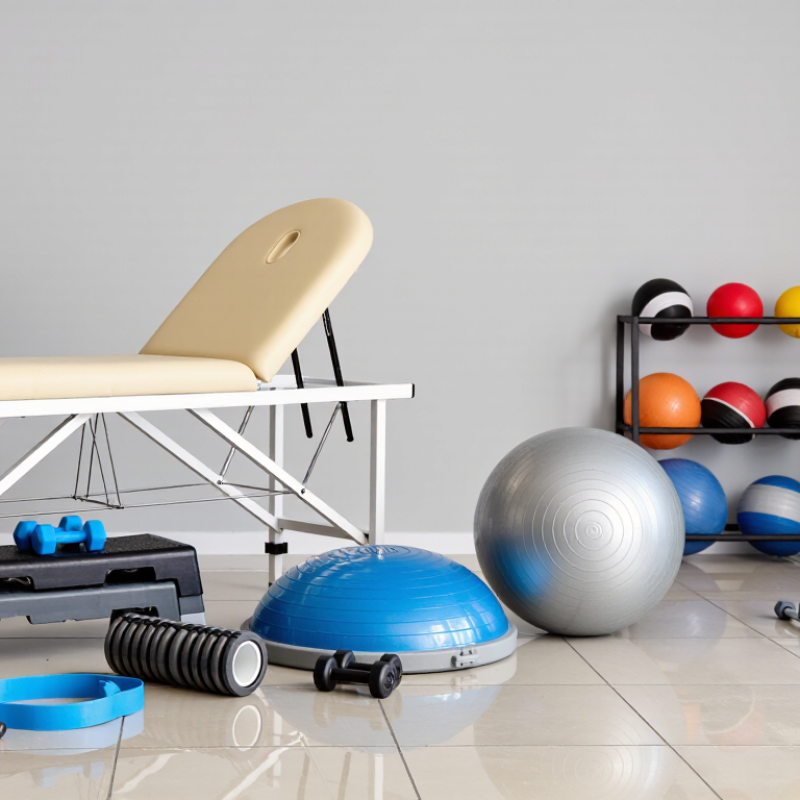
A well-equipped physiotherapy space supports assessment and gradual, supervised movement.
An adjustable treatment table gives patients a stable place for hands-on care and exercises.
Resistance bands provide light, adaptable loading for shoulder or leg work.
Small dumbbells can build strength, while an exercise ball challenges posture and trunk control.
A balance pad adds a softer, less predictable surface. Use it only when the patient can manage the added challenge safely.
Foam rollers may help patients explore gentle self-massage, though they are not a cure-all.
A goniometer helps measure joint movement and track changes over time.
A pulse oximeter can check oxygen saturation when clinically appropriate, but readings need context.
Reusable hot and cold packs offer temperature-based comfort; protect the skin and follow professional guidance.
Walking aids, such as canes or crutches, can support mobility when fitted and taught correctly.
Small details matter. Clean shared equipment between patients, check bands for tears, and keep walking areas clear. A common oversight is choosing impressive equipment before clarifying the patient’s goals. The simplest tool may be the most useful, and progress can still be uneven.
How Each Tool Is Used in Treatment
Physiotherapy tools work best when matched to a patient’s goals, not used as a routine checklist. The World Health Organization estimates that 2.4 billion people worldwide live with conditions that may benefit from rehabilitation (WHO, “Rehabilitation,” 2023). That need makes careful assessment essential. An adjustable treatment table supports positioning and hands-on care. A goniometer measures joint movement, while a hand-held dynamometer records force during strength testing. Small details matter.
Resistance bands and dumbbells help patients build strength with adjustable loads. A balance board challenges postural control; an exercise ball can support trunk exercises or gentle mobility work. Foam rollers may help patients practise self-massage, though comfort and response vary. A TENS unit delivers electrical stimulation for pain relief in selected cases, while therapeutic ultrasound applies sound-wave energy to targeted tissue. Neither modality replaces active rehabilitation or suits every patient. I still find it easy to overvalue equipment; the patient’s response should guide each session. Record changes in pain, movement, and function, then adjust the plan.
What Are the Top 10 Physiotherapy Tools and Equipment? — How Each Tool Is Used in Treatment
| Tool or Equipment | Primary Purpose | How It Is Used in Treatment | Practical Consideration |
|---|---|---|---|
| Resistance Bands | Progressive strengthening and mobility exercises | Patients pull against the band to work specific muscle groups or perform controlled joint movements. Resistance can be adjusted by changing the band or its stretch. | Choose resistance that allows controlled movement without provoking excessive pain or loss of form. |
| Therapy Balls | Trunk control, balance, and functional exercise | A therapist may use a ball as a support surface or exercise tool for sitting balance, core control, gentle mobility, or selected strengthening activities. | Use an appropriately sized ball and provide support when balance or fall risk is a concern. |
| Foam Rollers | Self-massage and movement preparation | Patients use body weight to roll over selected muscle areas as part of a mobility or warm-up routine. A therapist can guide positioning and pressure. | Pressure should be comfortable; avoid rolling directly over bones, injured areas, or other sensitive structures. |
| Goniometers | Measurement of joint range of motion | The therapist aligns the instrument with anatomical landmarks to measure joint angles and track movement over time. | Consistent positioning and technique help make repeated measurements more comparable. |
| Handheld Dynamometers | Assessment of muscle strength | The patient pushes or pulls against the device while the therapist applies resistance, helping quantify force during selected strength tests. | Results depend on standardized test positions, instructions, and consistent application of resistance. |
| Balance Pads | Balance and proprioception training | Patients perform standing or weight-shifting exercises on a compliant surface, progressing from supported tasks to more challenging activities as appropriate. | Use close supervision and a stable handhold when needed to reduce fall risk. |
| Parallel Bars | Supported standing and gait practice | Patients use the bars for stability while practicing standing, weight transfer, stepping, and walking patterns under therapist supervision. | Adjust the task to the person’s mobility, balance, and level of assistance required. |
| Hot and Cold Packs | Short-term symptom management | Heat or cold may be applied for a limited period to help manage symptoms or prepare for activity, alongside an individualized rehabilitation plan. | Protect the skin with an appropriate barrier and monitor comfort and skin response; these packs do not replace active rehabilitation. |
| TENS Unit | Temporary modulation of pain symptoms | Electrodes deliver low-voltage electrical stimulation through the skin. A clinician can advise on placement and settings for appropriate cases. | Suitability varies; follow device instructions and seek clinical advice, especially with implanted electronic devices or altered skin sensation. |
| Therapeutic Ultrasound Unit | Adjunct modality in selected treatment plans | A trained clinician moves an ultrasound applicator over the skin using coupling gel. It may be considered as one component of care for selected conditions. | Its benefits vary by condition, and it should not replace exercise or other evidence-informed treatment when those are indicated. |
How to Choose Equipment for Different Rehabilitation Goals
Choose physiotherapy equipment by the movement or daily task a person needs to improve, not by popularity. A therapist can assess strength, balance, mobility, and pain before recommending tools. The same resistance band may help one person build shoulder strength, yet feel too difficult for someone recovering from an injury. Small details matter. A stable chair, clear floor space, and comfortable grip can make practice safer and easier to repeat.
For gentle strengthening, light resistance bands or hand putty offer adjustable effort. Balance pads and low steps can support progressive balance or stair practice, but only when the user can work safely near a stable support. A therapy ball may suit controlled trunk exercises; it is not right for everyone. For restricted mobility, a stretching strap can help guide movement without forcing a joint. Equipment should match the person’s current ability and clinical plan. It is easy to overbuy, and I would reconsider any tool that stays unused after the first week.
Tips: Check the tool’s condition and follow a clinician’s instructions. Start with a light resistance or low step. Stop if exercise causes sharp pain, dizziness, or unusual symptoms, and ask a qualified professional what to change. A brief note on repetitions and comfort can help track progress.
Safety, Care, and Maintenance of Physiotherapy Equipment
Physiotherapy tools, from treatment tables and resistance bands to electrotherapy devices, need regular care to remain safe and dependable. Before a session, check table locks, cables, plugs, straps, and handles for cracks, fraying, or loose fittings. Small details matter. Ask about discomfort, skin sensitivity, and relevant health concerns before choosing equipment. Follow the device instructions and your clinical training.
Clean contact surfaces between patients using a method suitable for the material and device. Harsh cleaners can damage padding or leave residue, so check care instructions rather than guessing. Keep equipment dry before storing it. Replace damaged bands and worn straps; tape is not a reliable repair for load-bearing parts. For electrical devices, inspect leads and unplug them before cleaning, as directed by the manufacturer.
Store smaller tools in a clean, dry area, away from direct sunlight and heavy objects. Keep cords loosely coiled to reduce strain, and arrange equipment so people do not trip over it. Record faults and remove questionable items from use until they have been checked. A checklist helps, though it cannot replace careful observation. That takes practice. Even good routines can miss a worn seam or loose connector, so pause when something feels wrong.