
Blog

China Top 10 Copper Brazing Furnace Manufacturers

China’s copper-processing sector serves demanding markets, from heat exchangers to automotive components. The International Energy Agency’s Global Critical Minerals Outlook 2024 projects copper demand rising from about 26 million tonnes in 2023 to roughly 31 million tonnes by 2035 under its Stated Policies Scenario. That growth makes dependable joining equipment more important. A Copper Brazing Furnace must hold a stable temperature, support repeatable cycles, and fit the alloy and component geometry. Small temperature swings matter. So does atmosphere control.

This guide examines ten Chinese manufacturers through practical criteria: furnace type, temperature uniformity, production capacity, technical support, and verifiable quality documentation. David Pye, author of Practical Brazing, emphasizes a principle that remains relevant to furnace selection: clean surfaces and controlled heating help produce reliable brazed joints. This is a paraphrase of his technical guidance, not a direct quotation. Buyers should still verify claims with test data and application trials. A polished specification sheet is not enough. No ranking is perfect; product suitability depends on the actual process, not a company’s position on a list.
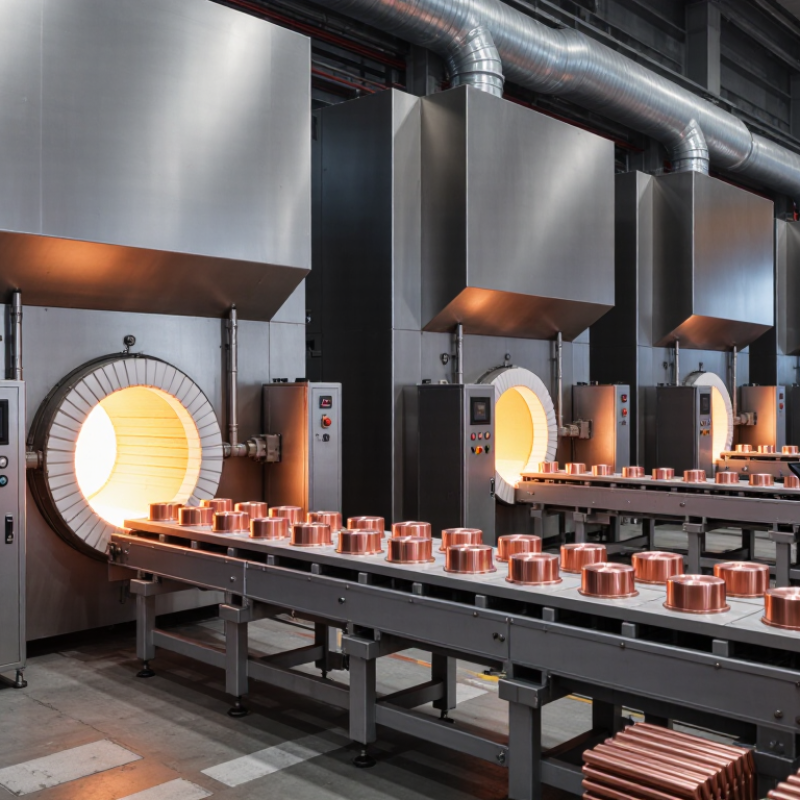
China Top 10 Copper Brazing Furnace Manufacturers

Copper Brazing Furnaces: Purpose and Industrial Applications

Copper brazing furnaces join copper parts by heating them with a filler metal that melts below the base metal’s melting point. Heat lets the filler flow into narrow joint gaps through capillary action. The copper stays solid. That distinction matters.

A furnace provides controlled, repeatable heating for batches or continuous production. Depending on the process, a protective atmosphere can limit surface oxidation and reduce post-braze cleaning. This is useful for copper tubes, fittings, heat exchangers, refrigeration assemblies, and electrical components. A well-made joint can support heat transfer and fluid flow, provided the parts are clean and properly fitted.

Results depend on more than furnace temperature. Joint clearance, filler selection, heating time, and atmosphere all affect the finished connection. Operators often check temperature uniformity and inspect sample joints before changing production settings. Small gaps can matter. In practice, a stable-looking furnace does not guarantee consistent joints; material variation and loading patterns can still change heating behavior. That deserves attention. These details make furnace selection and process validation important in high-volume manufacturing.

How Copper Brazing Furnaces Work and Their Main Types

A copper brazing furnace joins prepared components by heating them with a filler metal. The filler melts, flows into the narrow joint by capillary action, and solidifies as the assembly cools. The copper parts themselves should remain solid. Temperature control matters: uneven heating can leave a joint incomplete or distort thin tubing. Clean surfaces and consistent joint gaps matter, too. Small details count.

Many furnaces use a controlled atmosphere to limit oxidation during heating. Depending on the application, this may be a reducing gas or another specified process atmosphere. Operators monitor temperature, belt speed, and gas conditions. A bright surface can look reassuring, but it does not prove that the joint is sound. Inspection still matters.

Main furnace types include batch, continuous, and vacuum systems.

Batch furnaces suit varied parts loaded in fixtures, though each cycle takes time.

Continuous mesh-belt furnaces move components through heating and cooling zones, making them useful for repeat production.

Vacuum furnaces reduce oxidation without relying on a flowing process gas, but require careful loading and cycle planning.

No type is automatically best. Part geometry, filler choice, output volume, and joint quality requirements guide selection.

In practice, a well-designed process may still need adjustment after trial runs. That part is easy to underestimate.

Key Criteria for Evaluating Chinese Furnace Manufacturers

Choosing a Chinese copper brazing furnace manufacturer requires more than comparing quoted prices. Ask how temperature uniformity is measured across the usable hot zone, not just at one sensor. Request recent test records. Confirm that the furnace can maintain the specified atmosphere and heating cycle for your copper parts and brazing materials. Small temperature differences matter. They can affect joint appearance and consistency. Ask to see a sample process using parts similar in size and shape to yours, and clarify how production capacity is calculated.

Evaluate the controls, safety features, and maintenance access during a technical review. Can operators trace temperature and cycle data? Are common wear parts available, and how quickly can service staff respond? These details may matter more than an impressive brochure. Compare energy use using the same operating conditions, rather than relying on broad efficiency claims. A factory visit or live video inspection can help verify assembly quality and testing practices. Still, one demonstration cannot prove long-term reliability. Ask for references from comparable applications, review the warranty terms, and record any unanswered questions before signing a purchase agreement.

China Top 10 Copper Brazing Furnace Manufacturers - Key Criteria for Evaluating Chinese Furnace Manufacturers

Use these criteria to compare suppliers without relying on brand claims alone. Requirements depend on the brazing alloy, component design, production volume, and applicable safety regulations; confirm operating limits against your process.

Evaluation Criterion What to Verify Evidence to Request Practical Evaluation
1. Temperature range and control Confirm the furnace’s stated operating range covers the selected brazing alloy’s required process temperature and the complete heating cycle. Technical datasheet, control-system description, and a sample temperature record from a representative cycle. Check control stability at the intended setpoint and confirm that the displayed temperature represents the relevant work zone.
2. Temperature uniformity Ask how temperature variation is measured across the usable working zone and under what load, setpoint, and test conditions. Temperature-uniformity test report showing sensor locations, test conditions, measured values, and acceptance limits. Compare results with your product’s process requirements; do not compare figures taken under different test conditions as if equivalent.
3. Atmosphere control Verify compatibility with the specified process atmosphere, such as nitrogen, hydrogen-containing gas, or vacuum, where applicable. Gas-system diagram, atmosphere monitoring and alarm details, operating instructions, and any process trial data. Confirm the supplier can explain how atmosphere conditions are maintained throughout heating, brazing, and cooling.
4. Furnace sealing and atmosphere stability For controlled-atmosphere equipment, review the furnace design and the method used to check sealing, purge performance, and atmosphere stability. Sealing or leak-test procedure, purge sequence, maintenance guidance, and recorded test results when available. Ask how door seals, moving parts, and routine maintenance can affect atmosphere consistency in normal production.
5. Working-zone capacity and loading Check usable chamber dimensions, loading arrangement, fixture clearance, and compatibility with the size and shape of your parts. Dimensioned drawings, loading diagrams, fixture specifications, and a proposed layout for representative components. Assess usable capacity rather than external furnace dimensions; confirm that parts can be loaded consistently without obstructing circulation or heating.
6. Throughput and cycle time Establish the expected production rate using a clearly defined part, load configuration, recipe, and operating schedule. A cycle-time breakdown covering loading, heating, brazing, cooling, unloading, and any required preparation. Compare production estimates using the same assumptions, including changeovers and routine downtime.
7. Energy use and operating costs Review electrical power requirements and, where relevant, process-gas consumption under stated operating conditions. Utility requirements, equipment power data, and measured consumption information from a defined operating cycle if available. Ask for the conditions behind any consumption figure, including load, recipe, temperature, and production rate.
8. Controls, alarms, and process records Check recipe management, temperature sensing, alarm functions, data storage, and the ability to retrieve production records. Control-system description, sample data report, alarm list, and details of access, backup, and data export. Confirm that records capture the process information required by your quality system and can be understood by your operators.
9. Safety and regulatory suitability Review electrical, thermal, mechanical, and atmosphere-related safeguards, including risks associated with combustible or hazardous gases. Risk assessment, safety-device list, operating and emergency procedures, and documentation for applicable local requirements. Check compliance for the country and facility where the furnace will be installed; requirements can differ by jurisdiction and process.
10. Service, commissioning, and parts support Clarify installation and commissioning scope, operator training, warranty terms, troubleshooting support, and availability of replacement parts. Written service scope, warranty document, spare-parts list, maintenance schedule, and response arrangements. Ask which tasks require a supplier technician, what support is available remotely, and how critical parts can be sourced over the equipment’s service life.

Profiles of Ten Leading Copper Brazing Furnace Manufacturers in China

Profiles of ten leading Chinese copper brazing furnace manufacturers are most useful when they compare engineering capability, not marketing claims. A practical review should examine vacuum batch, continuous mesh-belt, pusher, roller-hearth, and bell-type designs, alongside temperature uniformity and atmosphere control. It should also check loading method, cooling-zone layout, production records, and access to replacement parts. Small details matter: a poorly placed thermocouple can make a neat temperature display misleading.

The International Copper Study Group’s World Copper Factbook 2024 reports about 26.5 million tonnes of refined copper production worldwide in 2023, with China the largest producer. This scale gives furnace makers a substantial industrial context, but it does not prove any supplier’s performance. Compare documented heating-zone measurements, repeatability across actual workloads, and references from similar production lines. Some public profiles lack comparable test conditions. That weakness deserves attention.

Tips: Ask for a sample process log and clarify how temperature uniformity was measured. Check service response times, not just rated output. A brief factory visit can reveal cramped maintenance access or awkward loading—details brochures often miss.

Comparing Product Capabilities, Quality Standards, and Support

Comparing China’s copper brazing furnace manufacturers should start with process fit, not brochure temperatures. Ask for temperature-uniformity maps, ramp-rate records, atmosphere or vacuum stability, and sample runs using your actual copper assemblies. The IEA’s Global Critical Minerals Outlook 2024 projects copper demand rising from about 26 million tonnes in 2023 to more than 30 million tonnes by 2035 under its Stated Policies Scenario. Repeatable joints and low scrap will matter as production needs grow.

Quality evidence should include traceable thermocouple calibration, batch records, maintenance schedules, and documented acceptance tests. Check quality systems against ISO 9001, but treat certification as evidence of management processes—not proof that every furnace performs equally. Request cross-sections and leak or strength results from representative brazed parts. Compare energy use per accepted batch, not just rated power. Review installation, operator training, spare-part lead times, and remote support. A fast response matters when a line stops. Small details matter. Specifications can still miss uneven loading, so arrange a witnessed trial where possible.

Tips: Send each supplier the same drawing, alloy, filler metal, cycle time, and acceptance criteria. Ask for a written service-response window and a sample production log.

China Top 10 Copper Brazing Furnace Manufacturers — Comparing Product Capabilities, Quality Standards, and Support

Thermal reference points for evaluating copper brazing furnace capabilities. These are process references, not manufacturer-specific performance data or a company ranking.

Brazing uses a filler metal with a liquidus temperature above 450°C; pure copper melts at approximately 1084.62°C. When comparing furnaces, check the specified operating range, temperature uniformity, atmosphere or vacuum control, quality documentation, and after-sales support against the requirements of your chosen filler metal and process.