
Blog
China Best Produce Clamshells Manufacturer for Global Buyers
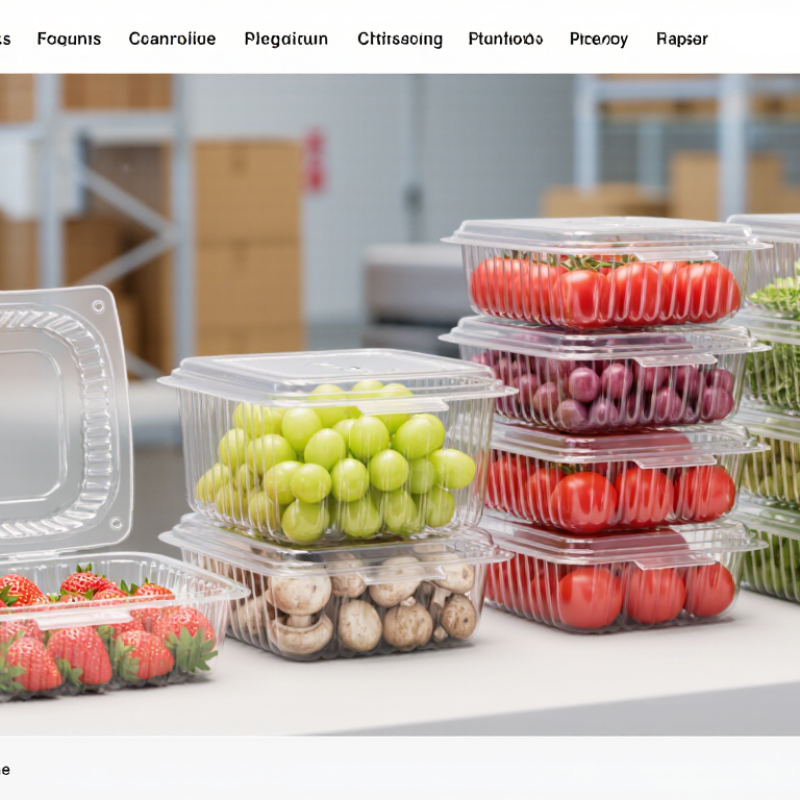
China has become a major sourcing base for fresh produce packaging, but choosing the right partner requires more than comparing prices. Global buyers need Produce Clamshells that protect berries, grapes, tomatoes, mushrooms, and delicate leafy products during handling and transport. A capable manufacturer should understand both packaging performance and real supply-chain pressure.
Experienced factories normally offer PET, rPET, or other food-contact materials with clear visibility and consistent wall thickness. Small details matter. Vent holes can reduce condensation. Secure hinges can prevent accidental opening. Smooth edges protect workers and delicate fruit. Reliable suppliers should also provide dimensional drawings, material information, production samples, and quality inspection records. Certifications and test documents must be checked carefully, not simply accepted from a sales brochure.
Production experience is useful, but it does not remove every risk. A clamshell may perform well in a factory test and fail inside a wet refrigerated truck. This is why practical trials remain valuable. Buyers should review stacking strength, seal quality, temperature exposure, print adhesion, and carton protection before large orders. Communication matters too. Clear specifications reduce misunderstandings about color, labeling, mold design, and delivery schedules. Some manufacturers respond quickly but overlook small details. That weakness deserves attention.
A dependable China Produce Clamshells manufacturer should support stable production, transparent communication, and continuous improvement. The best partnership is not always the cheapest one. It is the supplier that can explain limitations, correct mistakes, and maintain consistent quality across repeat shipments. For global buyers, careful evaluation creates safer packaging decisions and more predictable business results.
What Makes a Produce Clamshell Manufacturer the Best Choice
For global buyers, the best produce clamshell manufacturer offers more than attractive packaging. It combines stable quality, documented testing, and practical export experience.
The UNEP Food Waste Index Report 2024 estimates that 1.05 billion tonnes of food were wasted in 2022. Better packaging cannot solve waste alone, but it can reduce crushing, moisture loss, and handling damage.
Material selection matters. A reliable manufacturer should match resin, ventilation, hinge strength, and closure pressure to each crop. Berries need airflow and gentle locking. Tomatoes need stronger walls and improved impact resistance. Clear, uniform walls also help workers inspect bruising before shipment. Small details matter.
Traceability builds confidence.
Manufacturers should provide batch records, food-contact declarations, migration-test results, and inspection samples. These documents help buyers review compliance for their destination markets.
FAO has reported that 14% of food is lost between harvest and wholesale, showing why transport performance deserves serious attention.
A supplier should also test filled containers through stacking, vibration, temperature changes, and drop trials.
No clamshell is perfect. Excessive ventilation may dry delicate produce, while tight sealing can encourage condensation. This trade-off requires testing, not guesswork. Buyers should request production samples, compare actual tolerances, and inspect factory controls before placing large orders. A competitive Chinese manufacturer earns trust through repeatable results, honest limitations, and responsive corrective action—not only through a low quotation.
Key Materials Used in Produce Clamshell Packaging
China Best Produce Clamshells Manufacturer for Global Buyers
Produce clamshells commonly use PET, rPET, PP, or PLA. Each material changes clarity, strength, cost, and end-of-life handling. PET offers excellent transparency and stiffness. Shoppers can inspect berries without opening the package. It also performs well in chilled supply chains. However, PET can crack under heavy impact or poor stacking conditions.
rPET can reduce reliance on new plastic when certified food-grade content is available. Its color and clarity may vary slightly between production batches. That detail matters for premium produce displays. PP resists impact and handles warmer filling conditions better, but it usually looks less crystal clear. PLA is plant-based and useful for specific composting systems. It is not automatically compostable everywhere. Local facilities and accepted standards must be checked.
Tips: Ask for material specifications, food-contact documentation, and migration test results. Request samples with real produce, not empty trays. Test them after refrigeration, stacking, vibration, and humidity exposure. Small vent holes can reduce condensation, but excessive ventilation may accelerate moisture loss. In practical sourcing, the “greenest” option is not always the best option. A recyclable pack that local systems actually collect may perform better than a theoretically compostable one. Specifications sometimes look perfect on paper. Field testing can disagree.
Manufacturing Standards and Quality Control in China
For global produce buyers, a reliable clamshell begins with controlled manufacturing, not attractive samples.
Chinese factories should align food-contact production with GB 4806.7 and ISO 9001 quality systems. These requirements cover material safety, process control, traceability, and corrective action.
A professional factory checks resin certificates before molding. It also tests wall thickness, hinge strength, locking force, and seal performance. Sampling plans should follow recognized methods, such as ISO 2859-1.
For fresh produce, ventilation openings need consistent dimensions. Small variations can trap moisture and accelerate decay.
The OECD Global Plastics Outlook reported about 142 million tonnes of plastic packaging waste in 2019. That figure makes material reduction and responsible design practical priorities, not marketing language.
Effective quality control continues after production.
Inspectors should record temperature, pressure, cycle time, and mold changes for every batch. Finished clamshells need drop tests, compression checks, visual inspection, and food-contact documentation.
UNEP’s 2023 Turning off the Tap report says plastic pollution could be reduced by 80% by 2040 through system changes.
Recyclable mono-material designs can support that direction, when local recycling systems accept them. Reality is less perfect. A factory may pass appearance checks while missing a weak hinge.
Buyers should request retained samples, test reports, and batch traceability. Clear records build trust better than confident claims.
Customization, Sustainability, and Product Protection Options
Global buyers need clamshells that protect produce without creating unnecessary material.
As a China-based manufacturer, we develop clear PET, rPET, and compostable options for berries, grapes, tomatoes, and cut fruit. Vent holes can reduce condensation, while firm hinges help prevent crushing during transport.
Small details matter.
Customization should follow the product, not fashion. We adjust cavity size, wall thickness, locking strength, label area, and stacking design.
The OECD Global Plastics Outlook reports that only 9% of plastic waste was recycled globally in 2019. Therefore, using recycled content and designing for easier recycling deserves serious attention.
However, sustainability claims can become vague. Material certificates, food-contact documentation, and traceable production records are more reliable than attractive wording.
The design is not perfect. Thinner packaging may reduce material use but weaken protection.
Tips:
Test filled clamshells through vibration, compression, cold storage, and drop trials. Check airflow after washing. Confirm recycled content before printing claims. Ask for samples from the actual production mold.
Protection also supports food-loss reduction.
The 2024 UNEP Food Waste Index Report estimated 1.05 billion tonnes of food waste in 2022. A well-fitted clamshell cannot solve this problem alone, but it can reduce bruising, leakage, and handling damage.
For global buyers, the strongest option balances customization, verified sustainability, and practical product protection.
How Global Buyers Can Evaluate and Select a Supplier
China Best Produce Clamshells Manufacturer for Global Buyers
How Global Buyers Can Evaluate and Select a Supplier
Selecting a clamshell supplier requires more than comparing unit prices. Inspect the material, hinge strength, lid alignment, and ventilation design. A reliable supplier should explain resin type, recycled content, and food-contact documentation clearly. Ask for samples from regular production, not only polished showroom pieces. Test them with actual produce, cold storage, stacking pressure, and delivery handling. Condensation can reveal weaknesses that a clean sample hides.
Request a detailed specification sheet for every size. It should include dimensions, weight, closure force, color tolerance, and packing quantity. Check whether the supplier can maintain these details across repeated orders. Review quality records, batch traceability, inspection procedures, and corrective-action reports. Factory photos help, but an independent audit offers stronger evidence. A video call can also expose unclear production answers.
Communication quality matters during urgent changes. Confirm lead times, tooling ownership, minimum order quantities, payment terms, and export experience in writing. Ask how rejected goods are handled. Do not accept vague promises. A low quotation may exclude testing, stronger cartons, or protective loading methods. In practical sourcing, mistakes still happen. I once underestimated stacking pressure during a trial; the clamshells looked fine but cracked after transport. That result changed the evaluation process. Supplier selection should include real-use testing, not just attractive samples and fast replies.
China Best Produce Clamshells Manufacturer for Global Buyers - How Global Buyers Can Evaluate and Select a Supplier
| No. | Evaluation Dimension | Practical Buyer Benchmark | Evidence to Request | Weight | Supplier Score (0–5) | Weighted Score |
|---|---|---|---|---|---|---|
| 1 | Food-Contact Compliance | Material and finished packaging should comply with the destination market’s food-contact rules. For PET, verify the applicable requirements under EU Regulation 10/2011 or U.S. FDA 21 CFR 177.1630, as relevant. | Declaration of compliance, migration-test report, material specification, and traceability documents for each resin grade. | 20% | ____ | ____ |
| 2 | Material Selection | PET is widely used for clear produce packaging because it provides transparency, stiffness, and food-contact suitability. rPET content should be declared by percentage and supported by chain-of-custody documentation. | Technical data sheet, resin identification, recycled-content declaration, and batch-level material records. | 12% | ____ | ____ |
| 3 | Ventilation and Freshness | The design should provide airflow appropriate to the produce. Vent area, hole pattern, lid geometry, and product type must be validated through shelf-life or condensation testing rather than selected by appearance alone. | Ventilation drawing, sample test results, condensation observations, and produce-specific packaging trials. | 12% | ____ | ____ |
| 4 | Dimensional Accuracy | The supplier should control length, width, height, hinge position, lid alignment, and stackability against an approved drawing. Tolerances must be agreed before mass production because they vary by tooling and product size. | Approved CAD drawing, inspection standard, first-article report, and dimensional inspection records. | 10% | ____ | ____ |
| 5 | Closure and Tamper Resistance | The lid should close consistently, remain secure during handling, and open without excessive damage to the pack. If tamper evidence is required, the feature must be defined and tested separately from ordinary snap closure. | Closure-cycle results, opening-force measurements, transport simulation, and approved production samples. | 10% | ____ | ____ |
| 6 | Mechanical Performance | The clamshell should resist cracking, hinge failure, deformation, and compression during packing, palletizing, transport, and retail handling. Tests should use the buyer’s actual pack weight and distribution conditions. | Compression, drop, vibration, hinge-cycle, and stacking-test procedures with recorded acceptance criteria. | 10% | ____ | ____ |
| 7 | Quality Management | A documented quality system should cover incoming material, in-process inspection, hygiene, nonconforming product, corrective action, and lot traceability. ISO 9001 certification is useful evidence but does not replace food-contact compliance. | Valid certificate, process-control plan, inspection records, internal-audit summary, and corrective-action examples. | 8% | ____ | ____ |
| 8 | Production Capacity and Tooling | Confirm that the supplier has suitable thermoforming equipment, mold capability, maintenance controls, backup arrangements, and capacity for the required order volume without compromising inspection frequency. | Factory audit, equipment list, production-flow chart, capacity statement, tooling ownership terms, and maintenance records. | 8% | ____ | ____ |
| 9 | Sustainability and Recyclability | Prefer designs that use one predominant polymer, minimize unnecessary material, and support the buyer’s local recycling system. Sustainability claims should identify the exact material, percentage, method, and market scope. | Material-composition statement, recycled-content evidence, environmental claim support, and end-of-life guidance for the destination market. | 5% | ____ | ____ |
| 10 | Commercial and Logistics Reliability | Evaluate total landed cost rather than unit price alone, including tooling, packaging, inland transport, ocean freight, duties, inspection, payment terms, and the supplier’s ability to meet agreed shipment dates. | Formal quotation, Incoterms, lead-time schedule, carton and pallet specifications, order-history references, and contingency plan. | 5% | ____ | ____ |
| Total Evaluation Score | 100% | / 5.0 | ____ / 5.0 | |||