
Blog
2026 Best Quartz Sink Types for Global Buyers
For global buyers, choosing the best quartz sink in 2026 means examining materials, manufacturing quality, installation conditions, and long-term service. A polished showroom sample is not enough. Water hardness, cabinet strength, shipping distance, and local repair access can change the buying decision. A deep single bowl may suit large cookware, while a divided bowl can improve preparation routines. Small details matter.
Kitchen designer Susan Serra, CKD, offers a useful principle: “A sink must earn its place through daily use, not showroom drama.” That idea fits quartz composite sinks especially well. Buyers should inspect the mineral percentage, resin quality, drainage slope, surface texture, and warranty language. Matte finishes can hide light marks, but they may show pale mineral deposits in hard-water regions. Dark colors look refined. They can also reveal soap residue more quickly.
This guide compares the leading quartz sink types for international projects, including single-bowl, double-bowl, workstation, farmhouse, and undermount models. It considers practical measurements, such as 200–230 millimeter bowl depths and cabinet compatibility around 800 millimeters. These figures are useful, not universal. Manufacturing tolerances differ. Installation errors happen. Even experienced buyers can overlook transport damage or replacement costs. That weakness deserves attention.
The recommendations emphasize tested construction, transparent certification, dependable packaging, and realistic after-sales support. A quartz sink should resist everyday stains, impact, and moderate heat, but it is not indestructible. Buyers should avoid placing extremely hot cookware directly inside it. Global suitability requires more than attractive design. It requires evidence, careful comparison, and honest expectations.
Quartz Sink Composition and Key Performance Characteristics
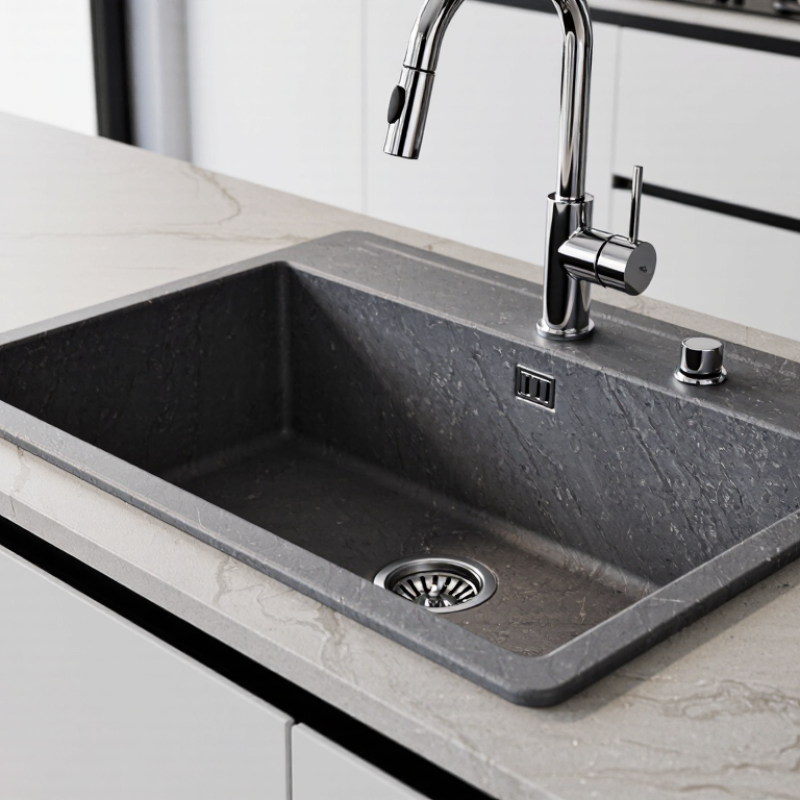
Quartz sinks are engineered composites, not carved blocks of natural quartz. Most contain finely crushed quartz aggregate, acrylic or polyester resin, mineral pigments, and curing additives. The aggregate supplies hardness and a stone-like feel. Resin binds the particles into a continuous, molded surface. Exact ratios differ by manufacturer, so buyers should request a technical data sheet. That small document matters. It can reveal filler content, thickness, water absorption, and test methods.
In daily use, the dense structure resists common food stains and absorbs little water. A dark coffee ring usually wipes away when cleaned promptly. Quartz composite also reduces metallic clatter from pans. Its mass helps the basin feel stable during washing. However, scratch resistant does not mean scratch proof. A dragged cast-iron pan can leave a visible mark, especially on a matte surface. High heat deserves caution. Place boiling cookware or hot trays on a suitable pad.
For global buyers, performance depends on more than composition. Check drain compatibility, corner radius, overflow design, mounting method, and local installation rules. A thick sink may need reinforced cabinetry. Measure the cutout twice. In humid coastal regions, inspect drain connections and underside sealing carefully. Poor support can damage an attractive sink. That is an easy lesson to miss. Ask for stain, impact, thermal-shock, and color-fastness test results from recognized laboratories. Also confirm replacement parts and care instructions in your market. Black finishes show mineral deposits clearly, while lighter finishes may reveal metal scuffs.
Main Quartz Sink Types by Shape, Mounting, and Bowl Configuration
Choosing among quartz sink types starts with three practical questions: shape, mounting, and bowl configuration. Rectangular sinks suit modern cabinet layouts and provide generous corners for trays. Rounded or gently curved bowls clean more easily, but they may waste valuable counter space. Houzz’s 2024 U.S. Kitchen Trends Study reports that undermount sinks remain the leading installation choice, selected in roughly two-thirds of renovated kitchens.
Mounting changes both appearance and maintenance. Undermount models create a continuous counter edge and allow crumbs to be swept directly into the bowl. Top-mount sinks are simpler to replace and can suit older cabinets with limited support. Flush-mount designs offer a level surface, yet installation tolerances must be extremely precise. Small errors become visible under bright kitchen lighting. Quartz composite is heavy, so cabinet reinforcement deserves attention, especially in long single-bowl models.
Bowl configuration should follow real cooking habits. A deep single bowl handles roasting pans and large cookware with fewer interruptions. A 60/40 double bowl supports washing and rinsing, although its smaller section may restrict wide pans. Equal double bowls feel organized but can reduce usable capacity. The NKBA’s recent kitchen design research continues to emphasize storage efficiency and functional work zones, not appearance alone. I would not choose the largest bowl automatically. Measure the cabinet, waste outlet, faucet reach, and user height first. That check is less exciting, but often more reliable.
| Classification | Main Type | Typical Size Range | Typical Bowl Configuration | Mounting Method | Key Advantages | Important Buying Considerations | Suitable Applications |
|---|---|---|---|---|---|---|---|
| Shape | Rectangular Quartz Sink | Overall length: 500–860 mm Overall width: 400–520 mm | Single bowl, 1.5 bowl, or double bowl | Undermount, top-mount, flush-mount, or integrated installation | Most efficient use of cabinet space; broad compatibility with standard kitchen worktops; easy to match with draining boards and accessories. | Confirm the minimum cabinet width, corner radius, cut-out template, drain position, and worktop thickness before ordering. | Residential kitchens, apartments, utility rooms, renovation projects, and general-purpose kitchen installations. |
| Shape | Square Quartz Sink | Overall length: 400–600 mm Overall width: 400–600 mm | Usually single bowl; compact 1.5-bowl options are also available | Undermount, top-mount, or flush-mount | Compact footprint; balanced appearance; suitable for small kitchens and narrow countertop layouts. | Usable internal capacity can be lower than a similarly sized rectangular sink; check bowl depth and corner radius. | Compact apartments, small kitchens, studio units, bars, and secondary kitchen areas. |
| Shape | Round Quartz Sink | Diameter: approximately 400–500 mm | Single bowl | Top-mount or undermount, depending on the model | Simple geometry; visually softens compact countertop designs; relatively straightforward circular cut-out. | Provides less usable corner space for large cookware; verify faucet clearance and cabinet structure. | Small kitchens, pantry areas, bar counters, guest suites, and compact food-preparation zones. |
| Shape | Corner Quartz Sink | Overall length: 800–1,050 mm Overall width: 800–1,050 mm | Usually double bowl, often with a central corner divider | Top-mount or flush-mount | Uses a corner cabinet efficiently; provides two separate washing areas without occupying a long straight worktop section. | Requires a suitable corner cabinet and careful plumbing access; corner installation may be more difficult to clean and service. | L-shaped kitchen layouts, large family kitchens, and projects with limited straight countertop length. |
| Mounting | Undermount Quartz Sink | Commonly available in 500–860 mm lengths | Single bowl, 1.5 bowl, or double bowl | Sink rim fixed below the countertop surface | Creates a continuous countertop line; crumbs and water can be swept directly into the bowl; clean, premium appearance. | Requires a compatible solid-surface, natural-stone, or engineered-stone worktop; the cabinet must support the sink weight; installation is less forgiving. | High-quality residential kitchens, stone worktops, contemporary interiors, and projects prioritizing easy countertop cleaning. |
| Mounting | Top-Mount Quartz Sink | Commonly available in 500–860 mm lengths | Single bowl, 1.5 bowl, or double bowl | Sink rim rests on top of the countertop | Fast and practical installation; the rim helps cover minor cut-out imperfections; suitable for many countertop materials. | Measure the rim width, clip or fixing system, cut-out dimensions, and faucet-hole arrangement; raised edges require additional cleaning. | Renovation projects, laminate worktops, rental properties, volume housing, and cost-conscious installations. |
| Mounting | Flush-Mount Quartz Sink | Commonly available in 500–860 mm lengths | Single bowl or double bowl | Sink rim sits level with the countertop | Nearly seamless transition between worktop and sink; combines a refined appearance with easy surface maintenance. | Needs highly accurate countertop fabrication and a compatible rim design; installation tolerances are tighter than top-mount models. | Modern kitchens, hospitality projects, premium residential interiors, and minimalist countertop designs. |
| Mounting | Integrated Quartz Worktop Sink | Project-specific; commonly based on a 600–1,200 mm sink area | Single bowl or custom multi-bowl arrangement | Sink and worktop formed as one coordinated surface | Very streamlined appearance; minimal visible joints; coordinated drainage and countertop design. | Usually requires specialized fabrication; replacement and repair can be more complex; confirm transportation and installation limitations. | Custom kitchens, designer interiors, commercial wash areas, and projects requiring a coordinated worktop system. |
| Bowl | Single-Bowl Quartz Sink | Typical bowl length: 400–760 mm Typical bowl width: 350–500 mm | One continuous bowl | Undermount, top-mount, or flush-mount | Offers the largest uninterrupted washing area; accommodates baking trays, stockpots, and large cookware more easily. | There is no separate bowl for rinsing or soaking; a removable colander or basin may be useful. | Large households, food preparation, compact kitchens needing maximum bowl capacity, and contemporary open-plan kitchens. |
| Bowl | 1.5-Bowl Quartz Sink | Overall length: approximately 760–1,000 mm | One full-size bowl plus one smaller auxiliary bowl | Undermount, top-mount, or flush-mount | Provides a useful secondary area for rinsing, food preparation, or waste separation while retaining a main washing bowl. | Needs more cabinet and countertop space; the smaller bowl may not accept standard cookware. | Medium and large residential kitchens, family homes, and buyers wanting flexibility without a full double bowl. |
| Bowl | Double-Bowl Quartz Sink | Overall length: approximately 780–1,200 mm | Two bowls of equal or unequal size | Undermount, top-mount, or flush-mount | Separates washing and rinsing tasks; supports simultaneous food preparation and dish handling. | Requires a wider cabinet and countertop cut-out; bowl width may be limited when washing large cookware. | Busy family kitchens, traditional layouts, catering areas, and users who prefer separated workflows. |
| Bowl | Low-Divider Double Bowl | Overall length: approximately 780–1,000 mm | Two bowls divided by a lowered central partition | Undermount, top-mount, or flush-mount | Combines separate washing zones with improved access for large pans compared with a full-height divider. | Water may pass between bowls more easily; check divider height, overflow design, and drainage performance. | Family kitchens, multi-tasking users, and buyers seeking a compromise between single- and double-bowl designs. |
| Bowl | Quartz Prep or Bar Sink | Overall length: 300–500 mm Overall width: 300–450 mm | Single compact bowl | Undermount or top-mount | Fits smaller cabinets and secondary work areas; useful for beverage preparation, rinsing, and light food handling. | Limited capacity for large cookware; confirm drain size, faucet reach, and available under-counter plumbing space. | Kitchen islands, entertainment areas, bars, pantry rooms, offices, and auxiliary food-preparation spaces. |
| All Types | General Specification Check | Verify model-specific dimensions before purchase | Depends on the selected configuration | Must match the countertop fabrication method | Reduces installation risk and helps ensure compatibility across international projects. | Check external dimensions, bowl depth, minimum cabinet size, cut-out template, drain opening, overflow, fixing hardware, packaging, and applicable local plumbing requirements. | All global residential, commercial, hospitality, and renovation projects. |
| Typical dimensions are indicative market ranges in millimetres. Actual dimensions, tolerances, bowl depth, drain position, corner radius, mounting requirements, and applicable standards vary by product specification and destination market. | |||||||
How to Compare Durability, Maintenance, Noise Control, and Hygiene
2026 Best Quartz Sink Types for Global Buyers
Quartz composite sinks combine mineral particles with resin, creating a dense surface for daily kitchen work. Their durability depends on composition, thickness, and installation quality. A deeper bowl handles large cookware, while a double bowl improves separation during washing. However, deeper models may require more bending. That detail matters.
For maintenance, matte quartz composite hides light marks better than glossy finishes, but it still needs prompt cleaning. Rinse away coffee, oil, and acidic food residue before they dry. Use mild soap and a soft sponge. Avoid abrasive powders and harsh solvents. Heat resistance varies, so place hot pans on a trivet. I once underestimated this habit; one careless pan can leave a visible change.
Noise control is a practical advantage. The dense material usually sounds quieter than thin metal when water or dishes hit the bowl. Added insulation beneath the sink can improve comfort further. Hygiene depends on cleaning, drainage, and surface condition, not marketing language. Choose a smooth, non-porous finish with rounded corners and a well-designed drain area. Inspect the underside, mounting hardware, and care instructions before purchase. Local water hardness also matters, because mineral deposits may demand more frequent wiping. No sink stays perfect. Reliable performance comes from matching the sink type to cooking volume, cleaning habits, cabinet support, and regional installation standards.
2026 Best Quartz Sink Types for Global Buyers
How to compare durability, maintenance, noise control, and hygiene across common quartz composite sink profiles.
Scores use a comparative 1–10 index based on material density, surface texture, resistance to staining and impact, ease of cleaning, and the natural sound-dampening properties of quartz composite. Higher scores indicate better overall performance.
Choosing Quartz Sink Types for Different Kitchens and Global Markets
Choosing a quartz sink depends on the kitchen, climate, installation method, and local buyer expectations. Quartz composite sinks combine mineral content with resin, creating a dense surface that resists everyday scratches and stains. Single-bowl models suit compact apartments and large cookware. Double-bowl designs help households separate washing and rinsing tasks.
European kitchens often need space-saving sinks with reversible drain positions. A low-profile undermount model creates clean countertop lines. North American buyers may prefer deep bowls or workstation designs for baking trays and meal preparation. In warmer markets, lighter colors can reduce the visual impact of dust and water marks. However, color alone does not guarantee easier maintenance.
Installation experience matters. An installer should check cabinet strength, countertop thickness, drainage height, and sealant compatibility before cutting the worktop. Top-mount sinks can simplify replacement projects. Undermount sinks require more accurate fabrication. Small errors become visible quickly.
Matte finishes look modern. They can also reveal mineral deposits. Dark surfaces often need frequent wiping in hard-water areas. Global buyers should request material specifications, impact testing, care instructions, and applicable plumbing documentation. Requirements differ between markets, so copied certificates may create confusion. I have seen attractive sinks fail because the cabinet opening was measured too early. A careful template check remains more valuable than a perfect product photograph.
2026 Buying Criteria: Standards, Sustainability, Cost, and Supplier Reliability
For 2026 global buyers, quartz sinks should be judged by evidence, not surface gloss. Undermount models suit seamless stone counters, while topmount models simplify replacement. Workstation designs add useful ledges, but their accessories can increase landed cost. Check quartz content, resin type, thickness, bowl depth, and heat resistance. NSF/ANSI 51 supports material suitability for food equipment, while EN 13310 covers functional requirements for kitchen sinks. These standards help, but they do not replace batch inspections.
Tips: Request a technical datasheet, test report, sample, and installation drawing. Compare delivered cost, not factory price. Include packaging, ocean freight, duties, cutout changes, accessories, and breakage allowances. A cheap sink may become expensive after one damaged shipment. It happens.
Sustainability claims need careful testing. UNEP’s Global Resources Outlook 2024 projects global resource extraction could rise 60% by 2060 from 2020 levels. The Circularity Gap Report 2024 estimates only 7.2% of global material use is circular. Ask suppliers for recycled-content evidence, production waste controls, water-use data, and an Environmental Product Declaration where available. ISO 14001 certification indicates an environmental management system, not automatically a low-impact product. Supplier reliability also needs proof: verify factory capacity, quality records, inspection access, warranty terms, and spare-part availability. I would request two recent production references. One certificate is never enough.